

Key takeaways
- A two-zone fire has a hot direct side (coals or embers) for searing and a cooler indirect side (none) for cooking through gently.
- It solves the most common outdoor cooking failure: a charred crust over a raw center, caused by cooking everything over one high heat.
- Build it by banking all the coals or embers to one half of the grill or fire ring, leaving the other half empty.
- Sear over direct heat, then move the food to the indirect side to finish to temperature without burning.
- It matters most when time and second chances are short, like a campground with fixed fire hours.
A two-zone fire is a fire with a hot side and a cool side: all the coals or embers banked to one half for searing, the other half left empty for gentle cooking through. It is the single most useful fire layout in outdoor cooking, and it fixes the most common outdoor cooking failure in one move.
An evening with a deadline
Picture a September evening at a campground in Yosemite Valley. The light is going off the granite, and you have a cooler with bone-in chicken thighs and a campsite fire ring in front of you.
You also have a clock. From May through September, wood fires in Yosemite Valley are only allowed between 5 pm and 10 pm (National Park Service, camping regulations). The wood came from the store near the campground, because the park asks visitors not to bring firewood from more than 50 miles away, to keep forest pests out. In the Valley you can only gather wood inside campground boundaries (same page).
So you get one fire and a few hours. If you get it wrong, there is no second attempt at 11 pm.
Stay Sharp. Stay Ahead.
Join our Telegram Channel for exclusive content, real insights,
engage with us and other members and get access to
insider updates, early news and top insights.
 Join the Channel
The classic way to get it wrong is the one everyone has eaten: a chicken thigh black on the outside and pink at the bone. The cause is almost always the same. The cook spread the heat into one even bed, got one temperature too hot for the thickness of the food, and had nowhere cooler to move it. The two-zone fire gives you that cooler place.
What the two zones are
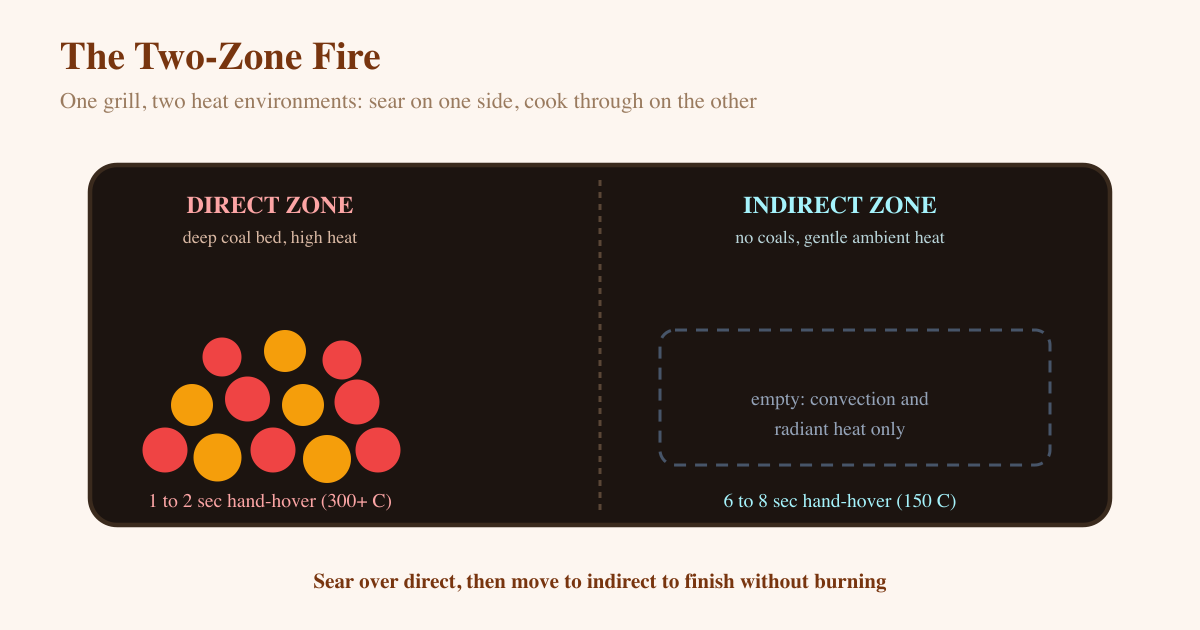
The direct zone sits directly over a deep bed of coals or embers. It is hot, often 300 degrees Celsius (about 570 degrees Fahrenheit) or more at the grate, the kind of heat that gives a 1 to 2 second reading on the hand-hover test. This zone sears, browns and crisps. It does the work of the Maillard reaction and the rendering of fat. It is also the zone that burns food if you leave it there too long.
The indirect zone sits over the empty half, where there is nothing burning beneath. Heat reaches the food by convection, especially under a lid, and by radiant heat from the other side. It is gentle, often around 150 degrees Celsius (about 300 degrees Fahrenheit), a 6 to 8 second hand-hover. This zone cooks food through to its target internal temperature without charring the surface.
The whole technique is the movement between them. Sear on direct, finish on indirect.
How to build one in a fire ring
Back at the campsite, a little after 5 pm:
- Build a wood fire and let it burn down. You do not cook on flames. You cook on embers. Give the fire time to collapse into a bed of glowing coals.
- Rake the embers to one side. Push them into a deep pile against one half of the ring. Depth matters more than spread: a deep bed holds heat longer.
- Leave the other side bare. That empty half is your indirect zone.
- Set the grate, if the ring has one. The area over the embers is direct heat; the area over the bare side is indirect.
- Wait five minutes, then test both zones with the hand-hover test.
The same layout works anywhere else you cook. On a charcoal kettle grill, light a full chimney of charcoal, pour the white-ashed coals onto one half of the charcoal grate in a deep pile, leave the other half empty, and set the cooking grate on top. On a gas grill, light the burners on one side and leave the other side off, and close the lid when working the indirect side.
The chicken, step by step
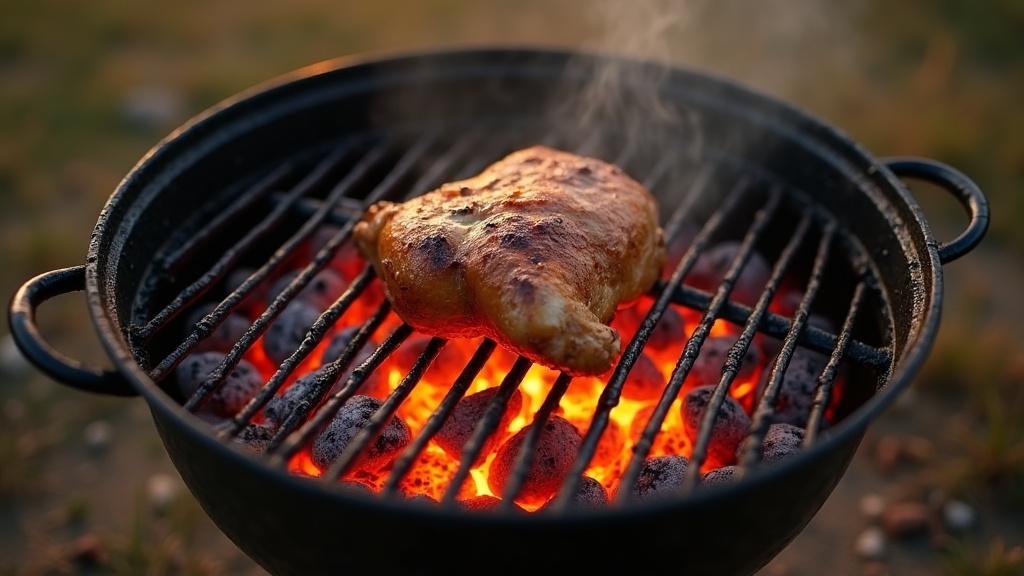
- Start on direct heat. Lay the thighs skin-side down over the embers. Sear until the skin is golden and crisp, a few minutes. The fat renders, the skin crackles, the browning develops.
- Move to indirect heat. Slide the thighs to the bare side, skin-side up. On a kettle or gas grill, close the lid so the trapped heat circulates. Over an open fire ring there is no lid, so this step takes longer: be patient, and turn the pieces now and then. Cook until the meat reaches 74 degrees Celsius (165 degrees Fahrenheit) at the thickest point, checked with a thermometer.
- Optional final sear. For extra crisp skin, give it thirty seconds back over the embers at the end.
The result is crisp skin and juicy meat cooked all the way through, well before the 10 pm deadline. The same workflow applies to thick steaks, pork chops, sausages, whole fish and bone-in cuts of every kind.
Why it works, in one sentence
Browning and cooking through are two different jobs that want two different temperatures. The two-zone fire lets you do both on one fire by giving you both temperatures at once. With a single zone you have to compromise; with two zones you can do one job after the other.
This connects to two other firecraft fundamentals: reading the coals to know when they are ready, and the hand-hover test to judge the heat of each zone. They are the senses that make the two-zone fire work in practice, not just on paper.
Common mistakes
- Embers spread too thin on the hot side. A shallow bed loses heat fast and never sears properly. Bank it deep.
- Cooking on flames instead of embers. Flames blacken the outside and give you no control. Wait for the fire to burn down.
- Forgetting the lid on the indirect side, when you have one. On a kettle or gas grill, the indirect zone works by trapped heat. An open lid lets it escape.
- Searing too long before moving. The direct zone is for crust, not for cooking through. Once you have color, move the food.
- Building the fire too small. You need enough fuel to bank deep on one side and still leave room for the empty side. With fixed fire hours, start early enough to let the fire burn down.
The takeaway
If you learn one fire layout, learn this one. It is the foundation that most other outdoor cooking techniques build on, from low-and-slow barbecue to reverse-seared steak. It turns a fire into something you can control. And on an evening when the rules give you one fire and a few hours, control is what gets dinner on the table.
Before any trip, check the park’s current fire rules: restrictions can change with fire danger and air quality. For Yosemite, see the National Park Service fire restrictions page.
Frequently asked questions
What is a two-zone fire?
A two-zone fire is a setup where you bank all the burning coals or embers to one side, creating a hot direct-heat zone, and leave the other side empty as a cooler indirect-heat zone. The direct side sears and browns; the indirect side cooks food through gently. You move food between the two zones depending on what it needs at each moment.
Why is a two-zone fire better than spreading coals evenly?
An even bed of coals gives you only one temperature, usually too hot for anything thick. Thick cuts char on the outside before the inside cooks. A two-zone fire gives you two temperatures at once, so you can sear over the hot side and then move the food to the cool side to finish without burning.
How do I build a two-zone fire on a kettle grill?
Light your coals in a chimney starter. When they are white-ashed, pour them onto just one half of the charcoal grate, banked into a deep pile. Leave the other half completely empty. Put the cooking grate on. You now have a direct zone over the coals and an indirect zone over the empty side.
Can I make a two-zone fire in a campground fire ring?
Yes. Let a wood fire burn down to a bed of glowing embers, then rake the embers into a deep pile on one side of the ring and leave the other side bare. If the ring has a cooking grate, the area over the embers is your direct zone and the area over the bare side is your indirect zone. Always follow the campground's fire rules and hours.
Stay Sharp. Stay Ahead.
Join our Telegram Channel for exclusive content, real insights,
engage with us and other members and get access to
insider updates, early news and top insights.
Join the Channel
Can I make a two-zone fire on a gas grill?
Yes, and it is even easier. Light only half the burners. The lit side is your direct zone, the unlit side is your indirect zone. Close the lid when using the indirect side so the trapped heat circulates like an oven.

Leave a Reply